Explore the monumental murals that transformed public spaces and defined a key chapter of Fogel's career.
A Public Canvas
Fogel's murals stand as vibrant testaments to the power of creativity, adorning walls across the nation with a rich tapestry of color and emotion. Each piece tells a unique story, engaging viewers in a dialogue that transcends the ordinary. From bustling urban centers to serene suburban settings, Fogel’s artistry invites us to pause and reflect, transforming public spaces into immersive experiences that celebrate culture, history, and the human spirit.
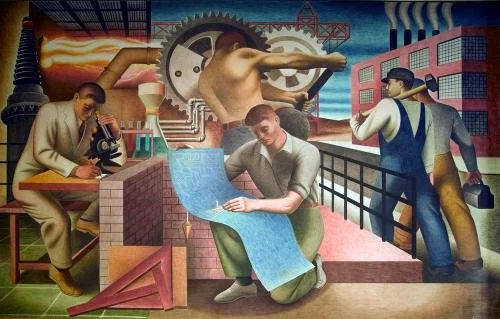
"The Wealth of a Nation" is a companion piece to Security of the People, also commissioned in 1941 and located in the Wilbur J. Cohen Federal Building. This mural celebrates the strength of America’s economy and labor force. It features imagery of industrial progress, agriculture, and scientific advancement, symbolizing the productivity and innovation that underpin the nation’s prosperity.
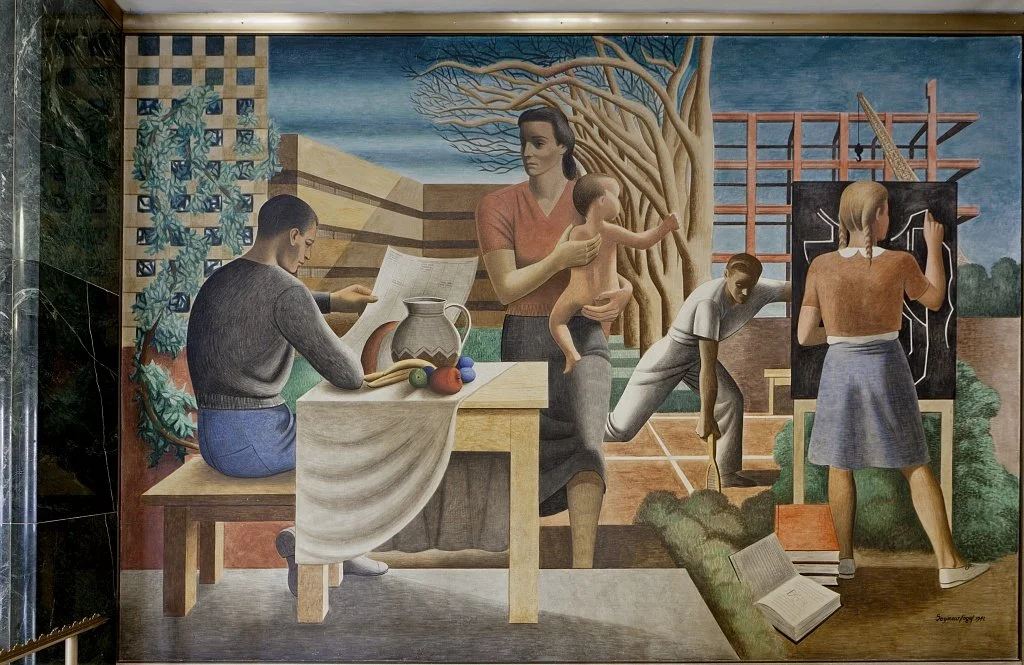
"Security of the People" is a prominent New Deal-era mural, commissioned in 1941 through the Section of Fine Arts. It is located in the lobby of the Wilbur J. Cohen Federal Building—formerly the Social Security Administration Building—in Washington, D.C. The mural depicts an American family surrounded by symbols of physical and intellectual well-being, embodying the core values and aspirations of the Social Security program.
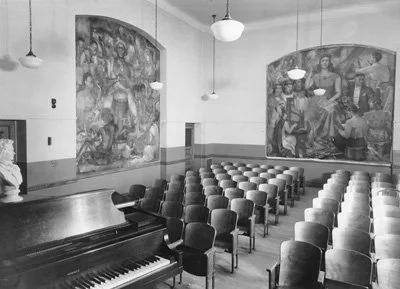
Pictured in black and white, these two murals, entitled “Religious and Modern Music” (left) and “African Music and European Music” (right), in the Music Room of the Abraham Lincoln High School were completed in 1937. The New York Schools website shows only a portion of the first mural on its Public Art for Public Schools pages, so it is uncertain if the latter mural is still displayed.
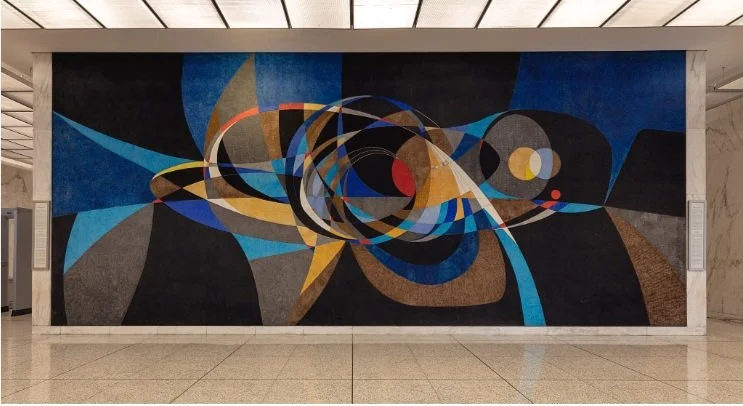
View of lobby with painting "Challenge of Space" of the Fritz G. Lanham Federal Office Building, located at 819 Taylor Street in Fort Worth, Texas. This 1966 mural is inspired by man's exploration of space and represents the major scientific leap forward in our time. It signifies the role Texas has played in the exploration of space.
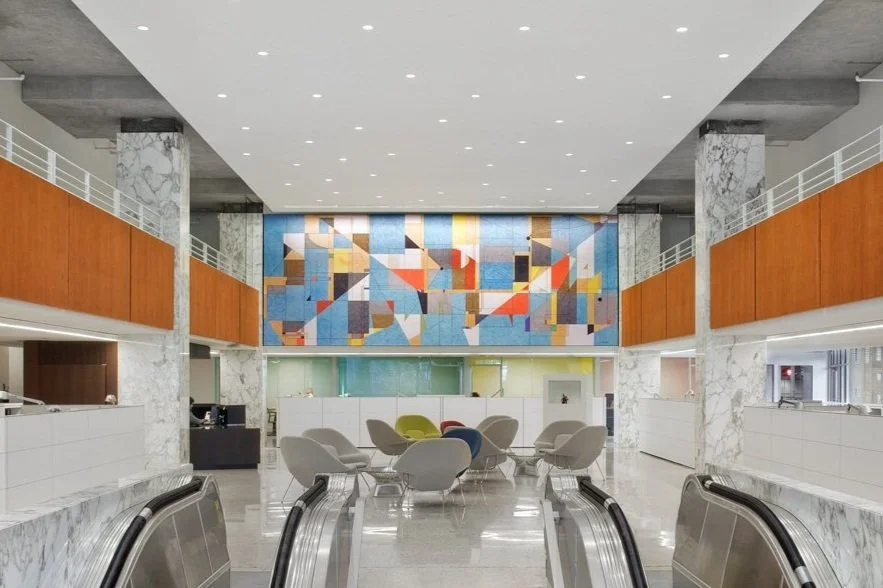
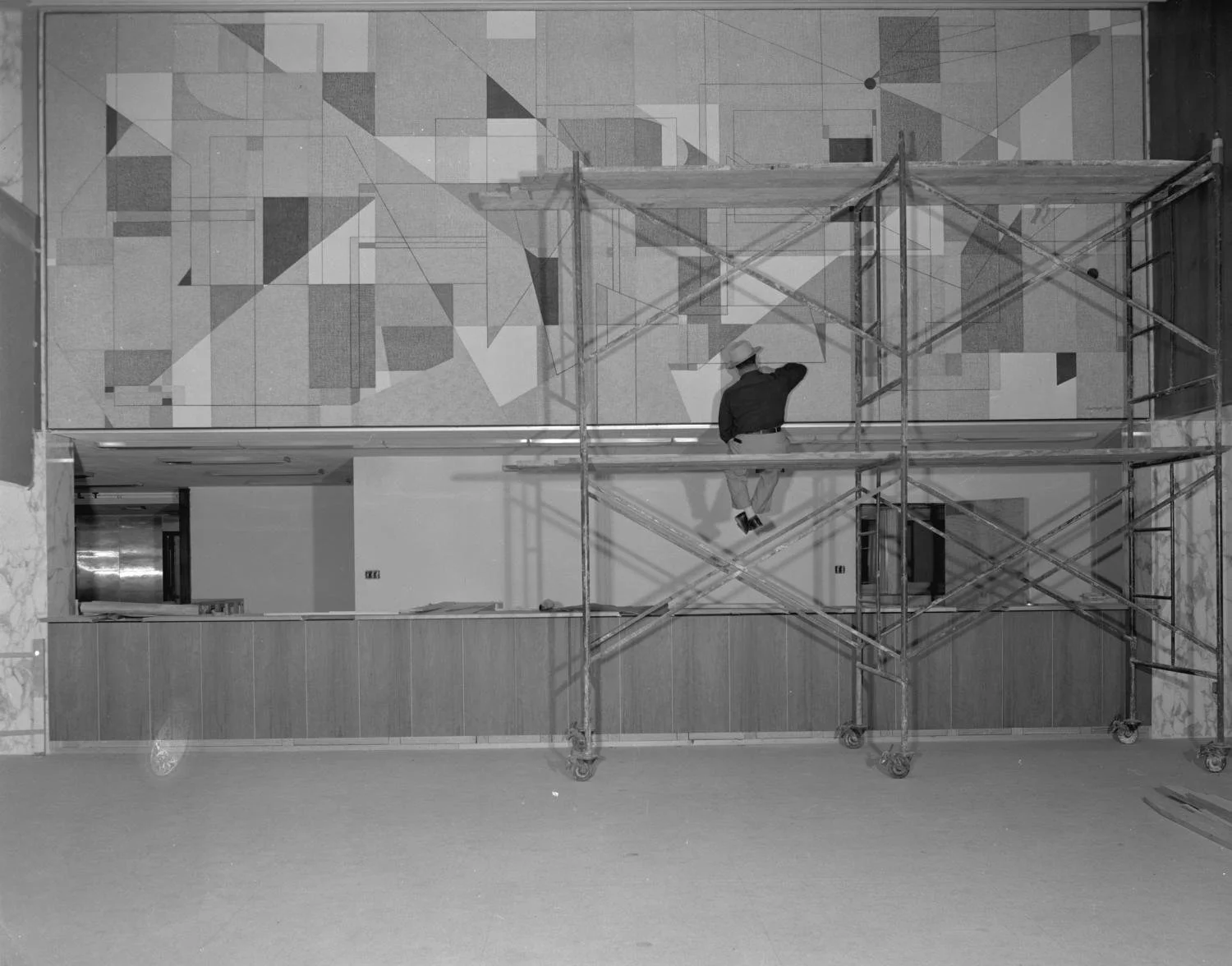
Seymour Fogel’s 1955 mural at the American National Bank (now the McGarrah Jessee Building) in Austin, Texas, is a landmark of mid-century modernism and one of the first fully abstract murals in the state. Created in collaboration with architect Howard Barr and designer Florence Knoll, the 10-by-30-foot piece features bold geometric forms and vibrant colors, designed to echo the building’s sleek, modern aesthetic.
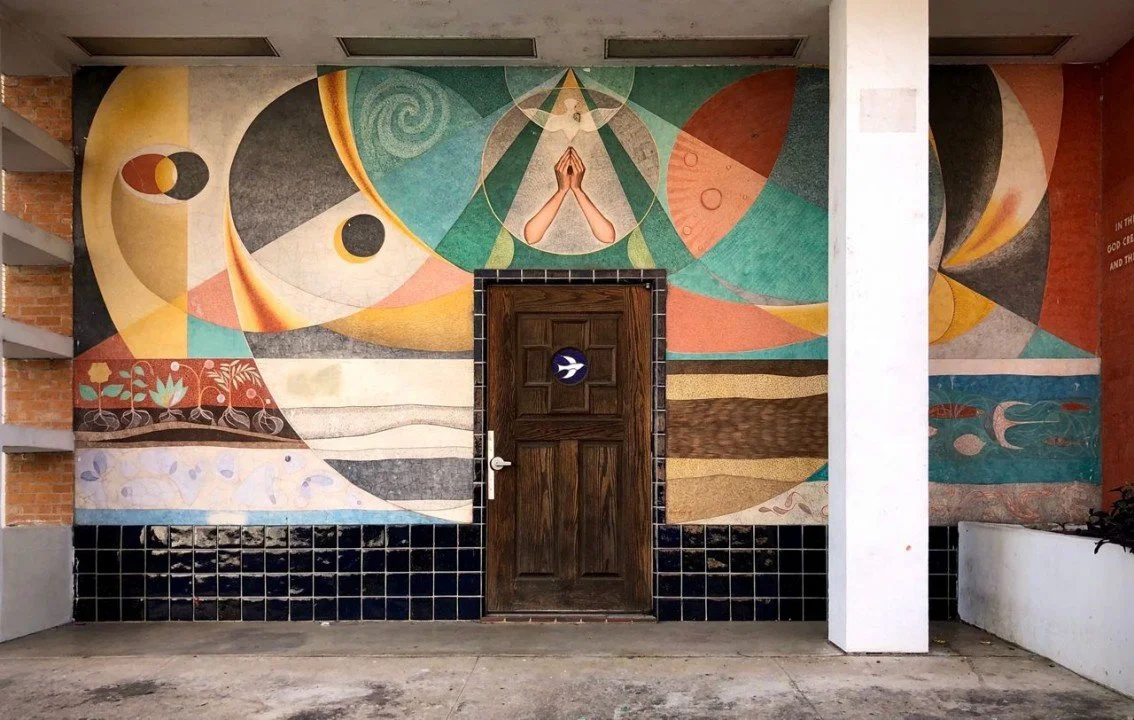
Commissioned by University Baptist Church in Austin, Texas, known as "Creation" or "Genesis", is considered to be the first mural in the city. Positioned above the church entrance, the abstract fresco features swirling orbs and concentric forms symbolizing the harmony of earth, ocean, and sky. Bold and unconventional for its time, the mural reflects Fogel’s shift toward spiritual and symbolic abstraction in public art.
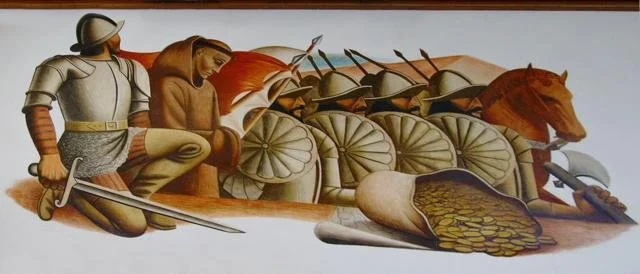
Painted in 1940 for the Safford Post Office under a New Deal public art program, "The Conquistadors"—in a six part series called "History of the Gila Valley"—depicts Spanish explorers and a priest arriving in the Southwest. Fogel’s bold forms and subdued palette set the tone for this six-part mural cycle—marking the arrival of conquest, faith, and cultural transformation in the region. (1/6)
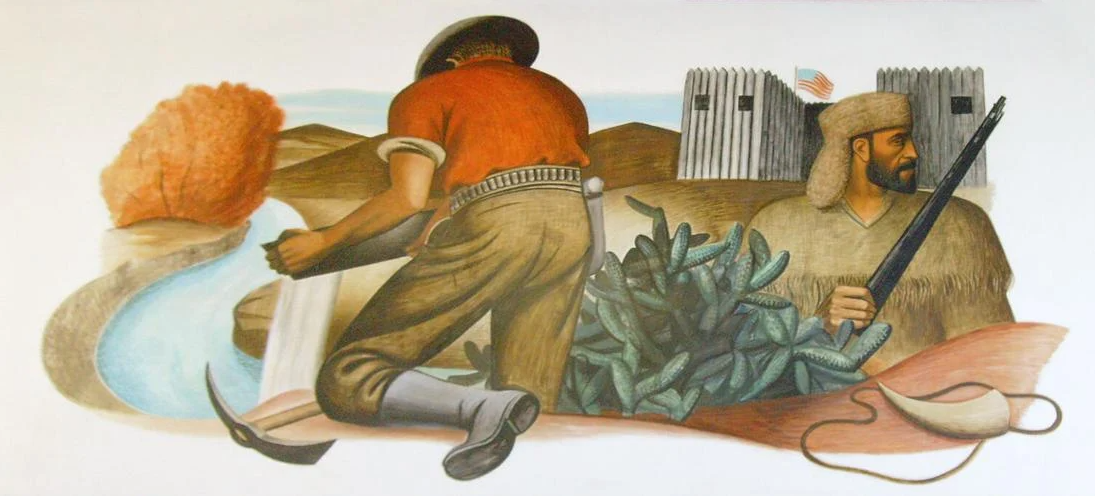
The second piece in the "History of the Gila Valley" series, "The New Land" shows a prospector and trapper—early agents of change in the Arizona wilderness. With stylized forms and muted light, Fogel evokes the lure of discovery, while hinting at deeper tensions between expansion and the lands it disrupted. (2/6)
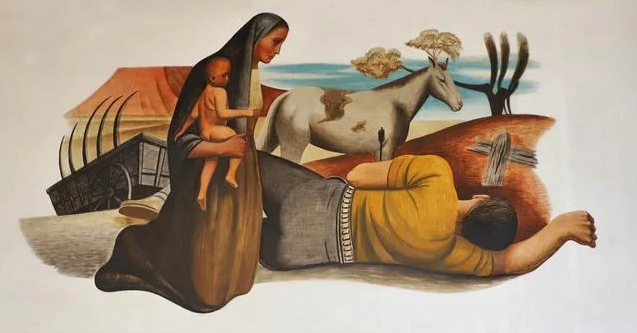
As the third piece in the "History of the Gila Valley" series, "Struggles" depicts a pioneer woman grieves beside her slain husband. Originally, Fogel proposed including Native American figures in a sympathetic light—an idea rejected by locals. This omission shaped a narrative of hardship without nuance, reflecting the era’s cultural limits. (3/6)
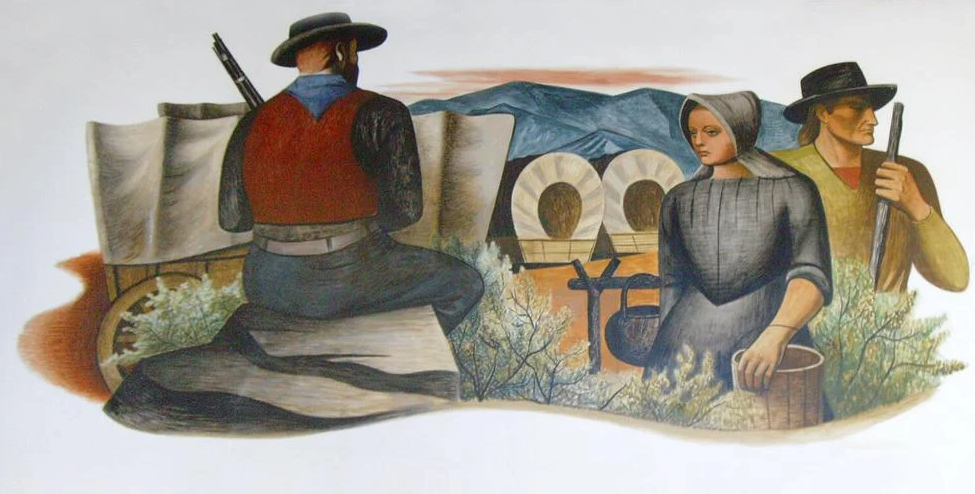
For the fourth piece in the "History of the Gila Valley" series, "Immigrants" shows circled wagons under night watch. Stark lines and quiet geometry convey the fear and fortitude of settlers. (4/6)
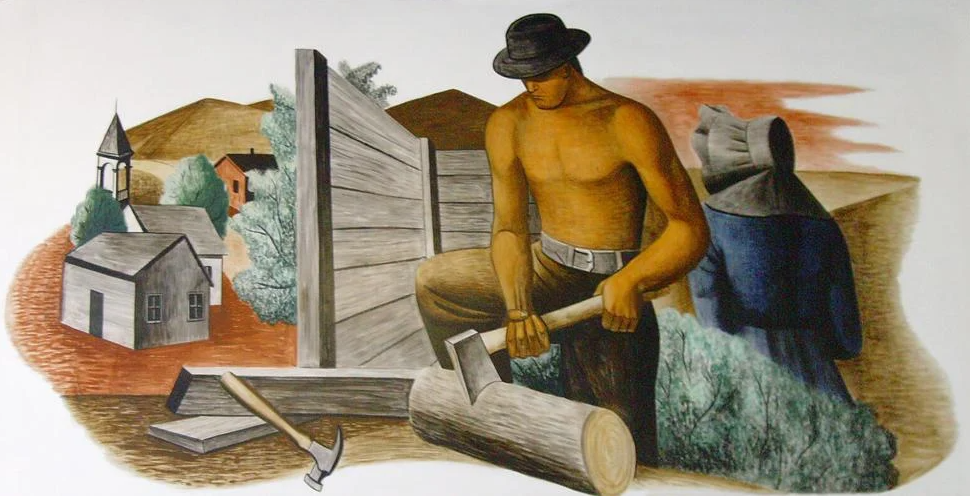
As the fifth piece in the "History of the Gila Valley" series, "Home" captures the beginnings of town life—a couple tending land, a church rising nearby. With softened forms and pastoral tones, Fogel paints hope emerging from hardship. (5/6)
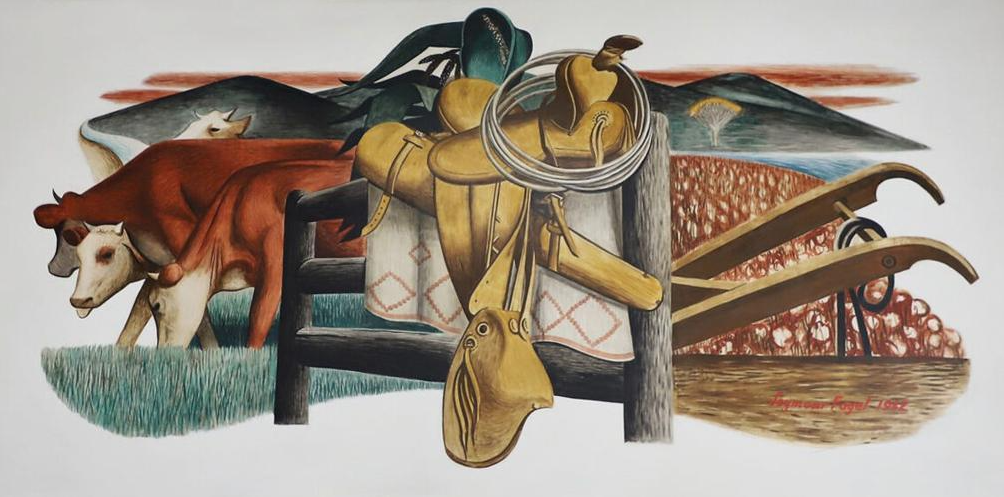
Closing Fogel’s "History of the Gila Valley" series, "Riches" celebrates cattle and open land—symbols of economic promise. Broad, rhythmic shapes suggest abundance, yet this prosperity rests on a selective story of settlement. (6/6)
Mural Commissions
Fogel was commissioned for countless murals across the nation through his 60-year legacy. Hear are a select few from different spaces the Estate has been able to learn about.
Public and Government Commissions
New York World’s Fair, Works Progress Administration Building, New York, 1939 — The Rehabilitation of the People, interior lobby, oil on canvas
Social Security Building (later the Health, Education, and Welfare Building), Washington, D.C., 1941 — The Wealth of the Nation and The Security of the People, interior, synthetic resin; in collaboration with Philip Guston and Ben Shahn
U.S. Post Office, Cambridge, Minnesota, 1941 — The Land and the People, interior, oil on canvas
U.S. Post Office, Safford, Arizona, 1941 — The History of the Gila Valley, interior lobby, synthetic resin; six panels of representational images
U.S. Federal Building, Fort Worth, Texas, 1966 — Challenge of Space, interior lobby, acrylic paint on prepared concrete
U.S. Federal Customs Building, Foley Square, New York City, 1968 — Exterior mosaic, 14' x 70'; the largest abstract mural commissioned by the General Services Administration at that time
Hospitals, Chapels, and Institutional Spaces
Bellevue Hospital, New York City, 1973 — Interior lobby, stained glass and steel; free-standing mural sculpture with seraphic, totemic imagery
Gouverneur Hospital Diagnostic and Treatment Center, New York, 1971 — Interior lobby mosaic
Phillips Chapel, Brooklyn Methodist Hospital, New York, 1958 — Interior chapel, ethyl silicate; inspirational abstract
Corporate and Commercial Commissions
American National Bank, Austin, Texas, 1953 — Interior wall, 12' x 28', ethyl silicate; rectilinear abstract
First Christian Church, Houston, Texas, 1956 — Exterior façade, glass brick and masonry; rectilinear design
First National Bank, Waco, Texas, 1955 — Two interior walls, ethyl silicate; rectilinear abstract
Hoffmann-La Roche, Corporate Towers, Nutley, New Jersey, 1964 — Interior lobby, cast panels of sand, wood, plaster, and paint, 22' x 32'
Petroleum Club, Houston, Texas, 1951 — Two interior murals in the lounge and grill, ethyl silicate
Schools and Universities
Abraham Lincoln High School, Brooklyn, New York, 1936 — Interior auditorium, oil on canvas; theme of classical and primitive music
Baptist Student Center, University of Texas at Austin, 1949 — Genesis, exterior entrance, ethyl silicate; Fogel’s first mural in Texas and his first abstract
Intermediate School 29 (later Hunter College Elementary School), New York City, 1970 — Interior lobby mosaics on Novaply panels, 10' x 52'
Park West High School, New York City, 1978 — Interior mosaic; rectilinear abstract
Phillips Hall, Ohio Wesleyan University, Delaware, Ohio, 1959 — Two interior murals in the auditorium lobby and student lounge, ethyl silicate
Public School 306, Brooklyn, New York, 1967 — Interior mosaic; rectilinear abstract
Public School 383, New York City, 1977 — Exterior courtyard mosaic; rectilinear abstract
University of Texas, Dental Branch, Houston, Texas, 1953 — Interior, oil on canvas; rectilinear abstract
A National Footprint
Explore an interactive map of Seymour Fogel's public works and murals across the United States.