In 1939, Seymour Fogel entered the United States Department of the Treasury’s Forty-Eight States Mural Competition, a national program intended to place a historically themed mural in a new post office in each of the forty-eight states.
For the new post office in Safford, Arizona, Fogel proposed a bold design centered on Native American culture. He researched tribal history in Smithsonian ethnological publications and studied ceremonial objects and religious materials at the Museum of the American Indian in New York City. The resulting concept was a technically brilliant, dramatic composition based on an Apache ceremonial mountain dance, and it won him the commission. Colleagues admired its modern approach, and some considered it the most abstract mural yet approved by the federal government.
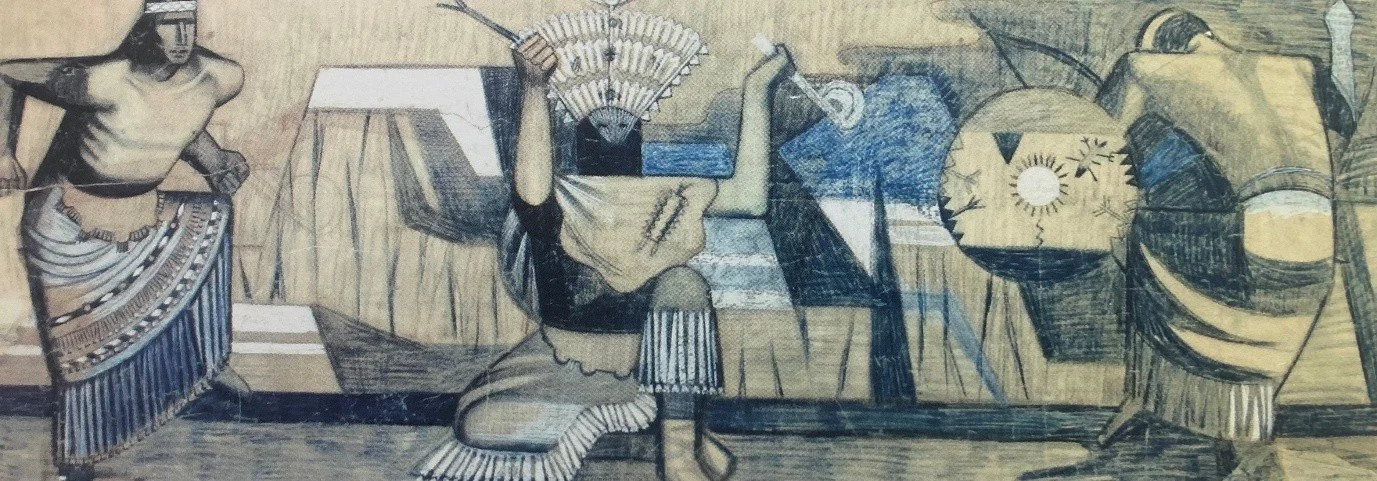
Apache Mountain Dance (1939) 17’’ x 42’’
The controversy began when the design reached the local community. In Safford, the Chamber of Commerce objected to any depiction of Apaches, describing them as “their chief enemy” and invoking family histories of violence and mistreatment. What followed were months of debate and negotiation among officials in Washington, public servants in Arizona, and Fogel in New York City. With the dispute unresolved, the Treasury Department assigned Fogel an interim commission in Cambridge, Minnesota, which proceeded on schedule and resulted in the mural The Land and the People (also known as People of the Soil), completed in 1941 and still on view in Cambridge.
Back in Arizona, Fogel ultimately produced a substantially revised proposal, influenced both by the subject matter dispute and a redesign of the post office building. The replacement mural was more representational and less abstract, executed as six tempera-on-gesso panels titled The History of the Gila Valley, with panels named Conquistadors, New Land, Early Pioneers, Migration, Home, and Fruits of the Valley. Although the redesigned mural was well received locally, it disappointed Fogel because it did not include a single Native American figure. Drawings from his original, Apache dance concept survive, including one reproduced in Democratic Vistas and others held by the Fogel estate, preserving a record of what he initially intended for Safford.